Genesis 4:11–26
We have been talking about the Story of the Bible, and I want to keep emphasizing that word Story, because one of the easiest mistakes we can make with the Bible is to reduce it to a collection of individual stories. We know the stories—David and Goliath, Noah and the ark, Joseph in Egypt, Daniel in the lions’ den, Esther before the king. But sometimes we take those stories out of the larger Story that the Bible is telling. David and Goliath becomes a story about overcoming your personal giants. Noah’s ark becomes a children’s story about animals getting on a boat, while sin and judgment almost disappear. Joseph becomes a formula for success: remain faithful, and eventually God will promote you. Daniel becomes a promise that if you are faithful enough, God will always keep you safe. Esther becomes a story primarily about discovering your personal destiny. But if we can tell any biblical story without connecting it to creation, ruin, rescue, and renewal, then there is a good chance we have made that story about us instead of seeing it as part of God’s Story.
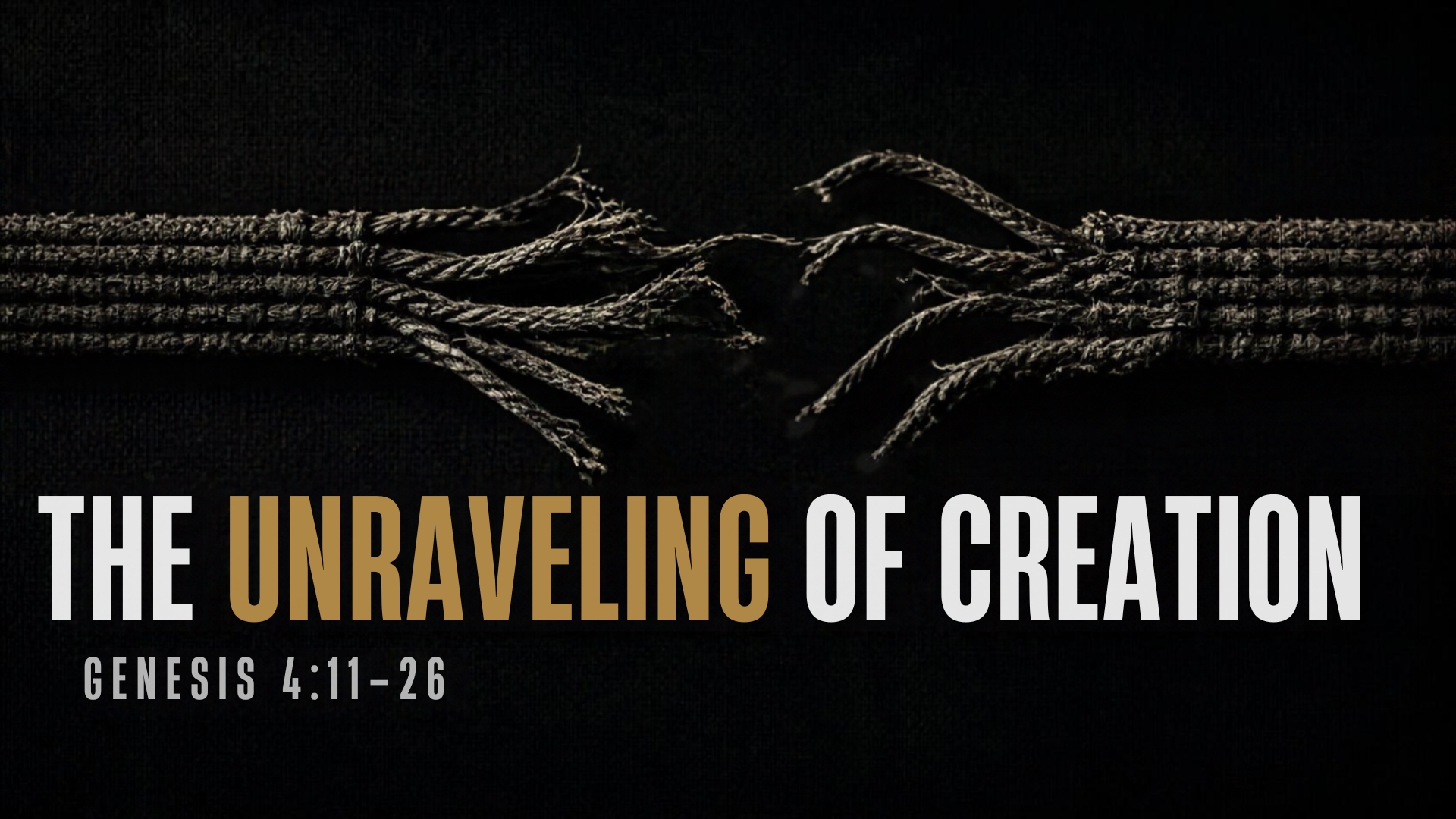
Genesis 4 is a particularly important chapter in that Story. Genesis 3 tells us that sin entered the world. Genesis 4 begins to show us what sin does once it gets loose in the world. We have already seen Cain murder his brother Abel, but Cain’s murder is not an isolated incident. It is part of something much larger. The fall of humanity is beginning to work its way outward. Relationships begin to break. Security begins to disappear. People distance themselves from God. Violence increases. Human beings begin constructing identities for themselves. And by the end of the chapter, a man named Lamech is actually boasting about his violence. The fabric of God’s good creation is beginning to unravel.
That idea of fabric may actually help us understand what is happening. In the Psalms, creation is described almost like a garment. Psalm 102 speaks of the heavens as something God changes like clothing, and Psalm 104 pictures God stretching out the heavens like a tent. The imagery is that God has skillfully fashioned His creation. Whenever I think about fabric, I remember something from childhood. When I was a boy, going with my mother to a fabric store felt like the closest a human being could come to death. I could not imagine anything more boring. Roll after roll after roll of fabric. Patterns. Thread. Buttons. I remember thinking that when I grew up, I never wanted to think about fabric again. And then I started reading the Bible.
I. God Wove Creation Together in Shalom
Fabric actually gives us a helpful picture of what God has done in creation. Think about a piece of fabric. Fabric may contain thousands of individual threads, but what makes it fabric is not simply that those threads are close together. You could dump a thousand threads into a pile, and you would not have fabric. Fabric exists because the threads have been woven together. They cross one another. They support one another. They are interdependent. In a sense, that is what God did when He created the world. Genesis 1 shows God bringing order out of disorder. He separates light from darkness and land from water. He creates plants and animals and then creates human beings. Everything has a place. Everything has a purpose. Everything exists in right relationship with everything else.
The biblical word that helps us describe that is shalom. We normally translate shalom as “peace,” but when we hear the word peace, we usually think about the absence of conflict. Nobody is fighting. Nobody is arguing. Everything is quiet. Biblical shalom is much richer than that. Shalom is creation functioning together the way God intended. It is wholeness, harmony, flourishing, things being rightly ordered. Physically, the parts of creation work together. Within us, our minds and wills and emotions work together. Socially, human beings live in right relationship with one another. And above everything else, humanity lives in right relationship with God. It is like thousands of threads woven together into one beautiful piece of fabric.
Proverbs tells us that God created and sustains that order through His wisdom. Wisdom is not simply knowing a lot of things. Biblical wisdom means living according to the grain of God’s creation. It means understanding how God designed life to work and then living accordingly. But Proverbs also tells us, “The fear of the LORD is the beginning of wisdom.” So where does wisdom begin? It begins with the fear of the Lord. And by fear, Scripture does not simply mean being frightened of God. To fear the Lord is to live with such an awareness of His greatness, His holiness, His goodness, and His love that He becomes the controlling reality of your life. You see everything in relationship to Him. You make your decisions in relationship to Him. You understand yourself in relationship to Him.
When human beings live in the fear of the Lord, they begin to live wisely, and where wisdom governs life, shalom flourishes. But when humanity rejects God’s wisdom, something begins to happen. The fabric starts to pull apart. The threads begin to loosen. Genesis 4 shows us the unraveling.
II. Sin Unravels Shalom
The first thing we see is that relationships unravel. Cain has murdered Abel. Think about how rapidly things have deteriorated. In Genesis 3, Adam and Eve sin against God. Immediately they hide from God. Then they begin blaming one another. Adam blames Eve. Before long, their son murders his brother. The unraveling is accelerating.
That is one of the things Scripture wants us to understand about sin. Sin never remains neatly contained inside the person who commits it. We sometimes think about sin as though it were an entirely private matter: “What I do is my business.” But sin does not work that way. Sin travels along the threads. It moves through marriages. It moves through families. It moves through friendships. It moves through churches. It moves through communities. Cain’s rebellion against God eventually becomes Cain’s violence against Abel, and Abel’s blood cries out from the ground. The relationship between human beings and God has been damaged. The relationship between human beings has been damaged. Even the relationship between human beings and the ground has been damaged. The fabric is unraveling.
Then security unravels. God says to Cain in verse 12, “When you work the ground, it shall no longer yield to you its strength. You shall be a fugitive and a wanderer on the earth.” Think about the contrast with the beginning of Genesis. Adam and Eve were placed in a garden. They had a home. They had provision. They had security. They belonged somewhere. But Cain becomes a wanderer. There is an irony in verse 16. Cain goes away from the presence of the Lord and settles in the land of Nod. The word Nod is related to the idea of wandering. Cain settles in the land of wandering. In other words, Cain may have an address, but he is never really at home. He may establish a location, but he is never truly settled.
That is one of the consequences of sin. You can have an address and still not have shalom. You can own a house and still not feel at home. You can accumulate possessions and still live with deep restlessness. You can build all kinds of security around yourself and still discover that nothing you build can quiet the disorder inside you.
Then our relationship with God unravels. Listen to Cain in verses 13 and 14: “My punishment is greater than I can bear.” What is striking is what Cain does not say. He does not say, “My sin is greater than I can bear.” He says, “My punishment is greater than I can bear.” There is not much evidence here of repentance. Cain is upset about what his sin has cost him, but there is a difference between being grieved over sin and being grieved over the consequences of sin. One kind of sorrow says, “I hate what I have done.” Another kind says, “I hate what happened to me because of what I did.” Cain seems much closer to the second.
That is another sign that shalom is disappearing. When we lose the fear of the Lord, we lose wisdom. And when we lose wisdom, we eventually begin treating God Himself as though He is the problem. Cain is not saying, “God, I have sinned against You.” He is saying, “God, Your punishment is too severe.”
Then identity unravels. Verse 17 tells us that Cain builds a city and names the city after his son, Enoch. Notice the significance of the word name in this chapter. Cain’s family builds something and attaches its own name to it. But when we come to verse 26, something very different happens: “At that time people began to call upon the name of the LORD.” Those are two very different approaches to life. One approach says, “I need to make a name.” The other says, “I need to call on a Name.” Cain’s line is building identity. The other line is receiving identity from God.
Human beings have been doing both ever since. We are constantly tempted to build something and then put our name on it—our career, our reputation, our accomplishments, our possessions, our family, our influence, even our ministry. We say, perhaps without ever putting it into words, “If I can build enough, achieve enough, accumulate enough, and have enough people respect me, then I will know who I am.” But anything you have to build in order to establish your identity can also be lost. And if your identity disappears when your achievement disappears, then your identity was never secure in the first place. Genesis 4 is showing us people attempting to create apart from God what only God can give them.
III. God’s Common Grace Restrains the Unraveling
Then something interesting happens in verses 20 through 22. Cain’s descendants begin developing civilization. One becomes associated with livestock. Another with musical instruments. Another with metalworking. Human beings are making technological and cultural advances. That matters because Scripture does not say that once human beings became sinful, they became incapable of producing anything good or beautiful. Quite the opposite. Even in a fallen world, human beings make music. They build cities. They develop tools. They create culture. They make discoveries. They learn how the world works.
This is one evidence of what theologians often call common grace. God continues giving good gifts even to people who do not acknowledge Him. He restrains the full effects of evil. Cain deserved immediate judgment, but God protected him. Cain continued to live. He had a family. Civilization developed. God did not immediately allow sin to consume everything. God’s mercy runs all through this chapter.
But Genesis also makes something very clear: human progress is not the same thing as spiritual progress. Cain’s descendants can develop agriculture. They can make music. They can work metal. They can build cities. But none of those things can cure the human heart. Human beings can become technologically advanced and morally bankrupt at exactly the same time. We can improve our tools without improving ourselves. We can become more sophisticated without becoming more righteous. We can build more impressive cities while becoming more violent people.
That becomes obvious when a man named Lamech enters the story.
IV. The Unraveling Reaches Its Climax in Vengeance
Listen to Lamech in verses 23 and 24: “Adah and Zillah, hear my voice; you wives of Lamech, listen to what I say: I have killed a man for wounding me, a young man for striking me. If Cain’s revenge is sevenfold, then Lamech’s is seventy-sevenfold.” Cain committed murder. Lamech writes a song about it. He boasts about violence. Then he takes a promise God had given Cain and applies it to himself. God had promised to protect Cain from human vengeance. Lamech takes that mercy and turns it into a boast. “If Cain is avenged sevenfold, then Lamech seventy-sevenfold.” In other words, “If you hurt me, I will make sure you pay. I will never let it go. My vengeance will be greater than your offense.”
That is what sin does when it reaches maturity. It not only damages relationships. It convinces us that the way to repair our wounds is to wound someone else. And there is a fascinating contrast later in the Bible. One day Peter will ask Jesus, “How often will my brother sin against me, and I forgive him? As many as seven times?” And Jesus answers, not seven times, but seventy times seven.
Do you hear the reversal? Lamech says, unlimited vengeance. Jesus says, unlimited forgiveness. Lamech says, “I will never stop making people pay.” Jesus says, “My people will become people who forgive.” Lamech represents where the unraveling of sin leads. Jesus shows us what the kingdom of God begins to put back together.
That brings us to the question Genesis 4 leaves hanging over everything. If the world is this broken, if human beings are this violent, if we are this restless, if we keep trying to manufacture our own identity, if even our progress cannot cure what is wrong with us, then how can God possibly restore shalom? How can the fabric ever be woven together again?
V. Christ Begins Reweaving What Sin Has Unraveled
There is something interesting about Cain’s words in verse 14. Listen to what Cain fears. He says he will be driven away. He will be hidden from God’s face. He will become a wanderer. He fears that someone will kill him. Cain is guilty, and Cain fears exile, separation, and death. But later in the Story of the Bible, another man will experience those things. Not a guilty man, but an innocent one.
Jesus Christ will be taken outside the city. He will experience abandonment. He will cry out, “My God, My God, why have You forsaken Me?” And He will die. The judgment guilty Cain feared eventually falls upon the innocent Son of God. That is the heart of the gospel. Jesus enters the unraveling. He does not stand at a distance from our ruined world. He steps into it. He experiences rejection, violence, alienation, suffering, and death. He bears the judgment of sin so that sinful people can receive mercy.
Cain received mercy he did not deserve. We receive mercy we do not deserve. And the only reason a holy God can forgive guilty people without ceasing to be holy is that Jesus has borne our judgment Himself. Because of Christ, we no longer have to live like Cain. We do not have to build a city and put our name on it so that our lives will matter. We do not have to construct an identity out of achievement. We do not have to answer every wound the way Lamech answered his. We do not have to save ourselves.
Genesis 4 ends with a quiet but enormously important statement: “At that time people began to call upon the name of the LORD.” That is the alternative to Cain. Cain builds a city and makes a name. The people of God call upon the Lord’s name. One says, “I will establish myself.” The other says, “I need God.” And that is where renewal begins. Not when we make a name for ourselves, but when we call upon His name, because God is more merciful than we are sinful.
Genesis 4 shows us a world unraveling—violence, alienation, restlessness, pride, self-made identity, bitterness, vengeance. Thousands of years later, we recognize every one of those threads. The world still looks like Genesis 4. Sometimes our families look like Genesis 4. Sometimes our churches look like Genesis 4. Sometimes our own hearts look like Genesis 4.
But Genesis 4 is not the end of the Story. The Bible begins with God creating a world in shalom. Sin tears that shalom apart. But God does not abandon what He made. In Christ, He enters the ruin. At the cross, He accomplishes our rescue. Through the gospel, He begins the work of renewal. And one day Jesus will return and finish what He has begun. Everything sin has pulled apart will finally be put right. Everything broken will be restored. Every relationship will exist under the perfect reign of God. There will be no Cain. There will be no Lamech. There will be no violence, no wandering, no alienation, no bitterness, no death. The fabric of creation will be whole again, and nothing will ever unravel it.
That is the Story of the Bible. Creation: God weaves a world of shalom. Ruin: sin pulls the threads apart. Rescue: Christ enters our broken world and bears our judgment. Renewal: God begins putting creation back together and promises one day to complete the work.
So the question Genesis 4 leaves us with is not simply, “Are you more like Cain or Abel?” The question is much bigger than that. Where are you looking for life in an unraveling world? Are you still trying to make a name? Are you still trying to build enough security around yourself to quiet your restlessness? Are you still holding wounds with the clenched fist of Lamech? Or have you called upon the name of the Lord?
Because the answer to a world coming apart is not for us to become better at holding all the pieces together. The answer is Jesus Christ. And in Him, God has already begun weaving the world back together.